Kasa Kiosk initiative launched
The first kiosk at Doddabele is now operational, with two more locations planned.
A citizen-led initiative in Kengeri
Kasa Kiosks give neighbourhoods a practical alternative to dumping waste along our roads.
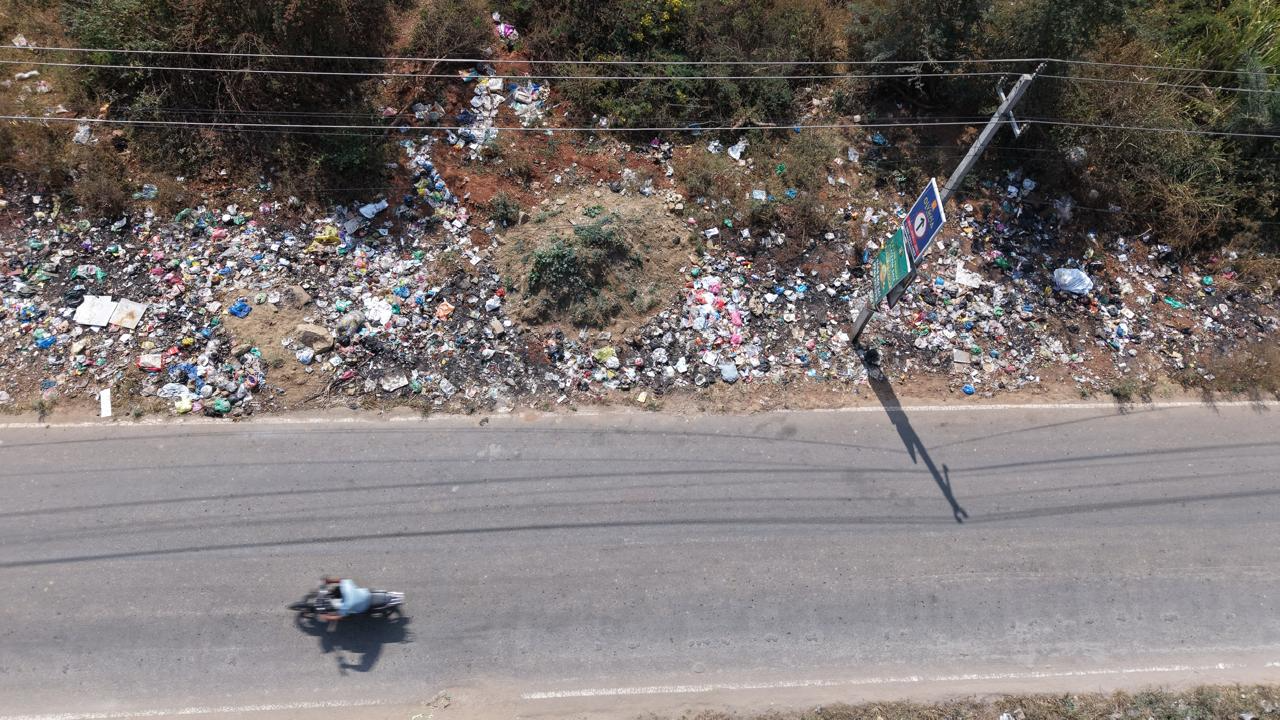
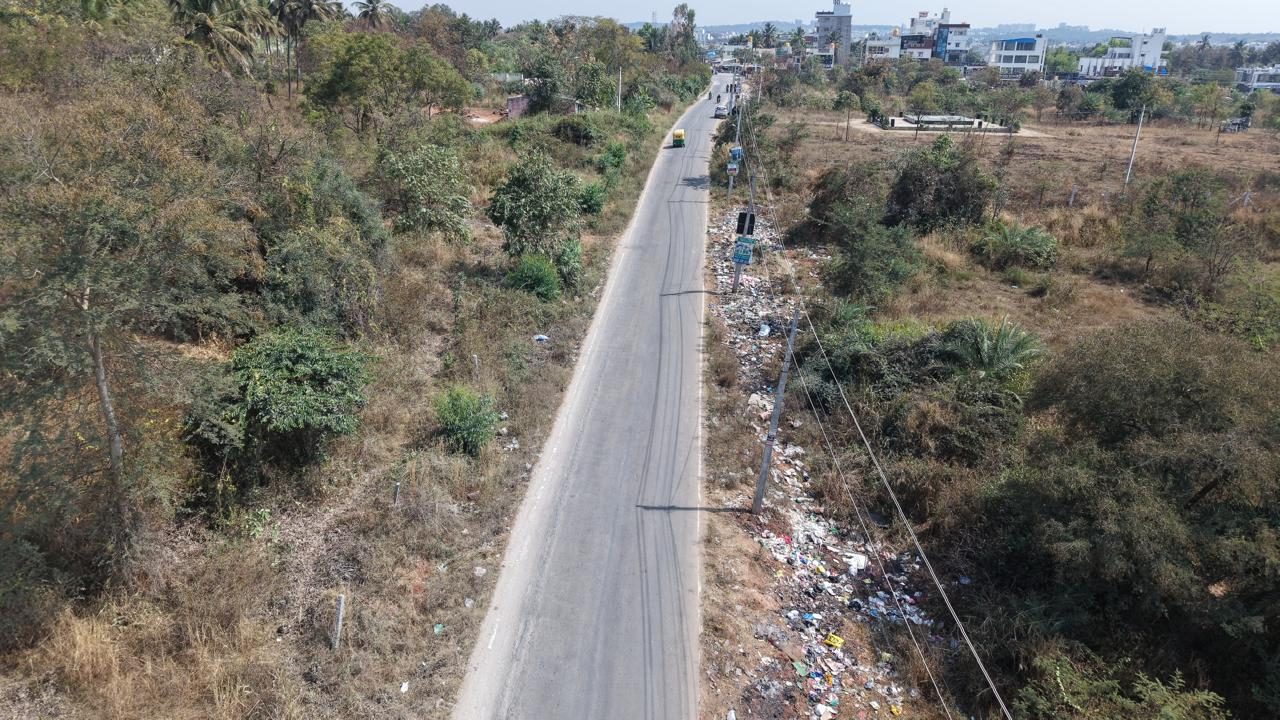
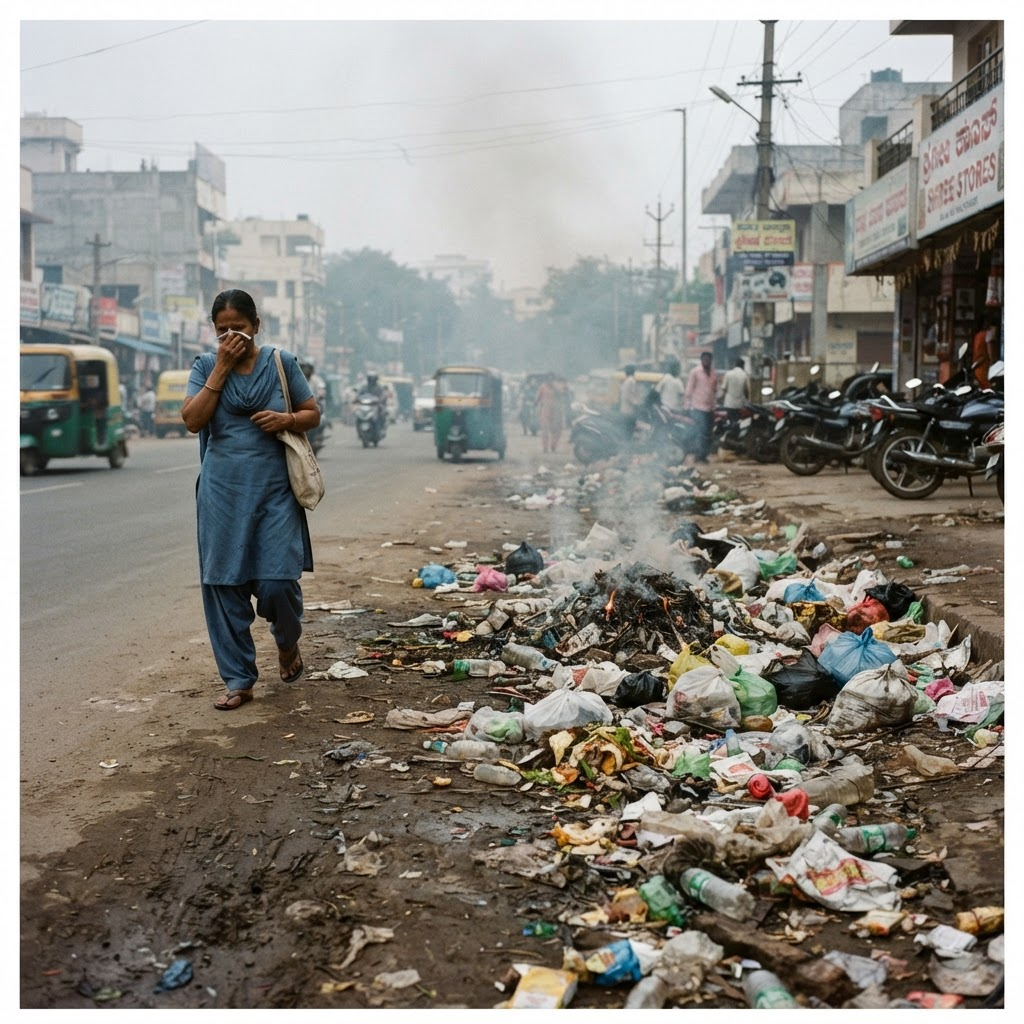
When waste has nowhere convenient to go, it ends up on the roadside. Burning it makes an already difficult problem worse — for our streets, our neighbours and our air.
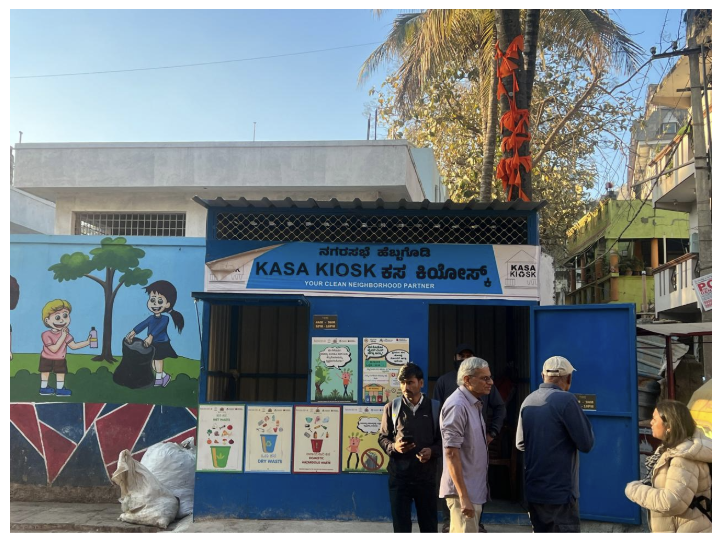
Kasa Kiosks are neighbourhood drop-off points for responsible disposal and segregation — making the right thing easy to do.
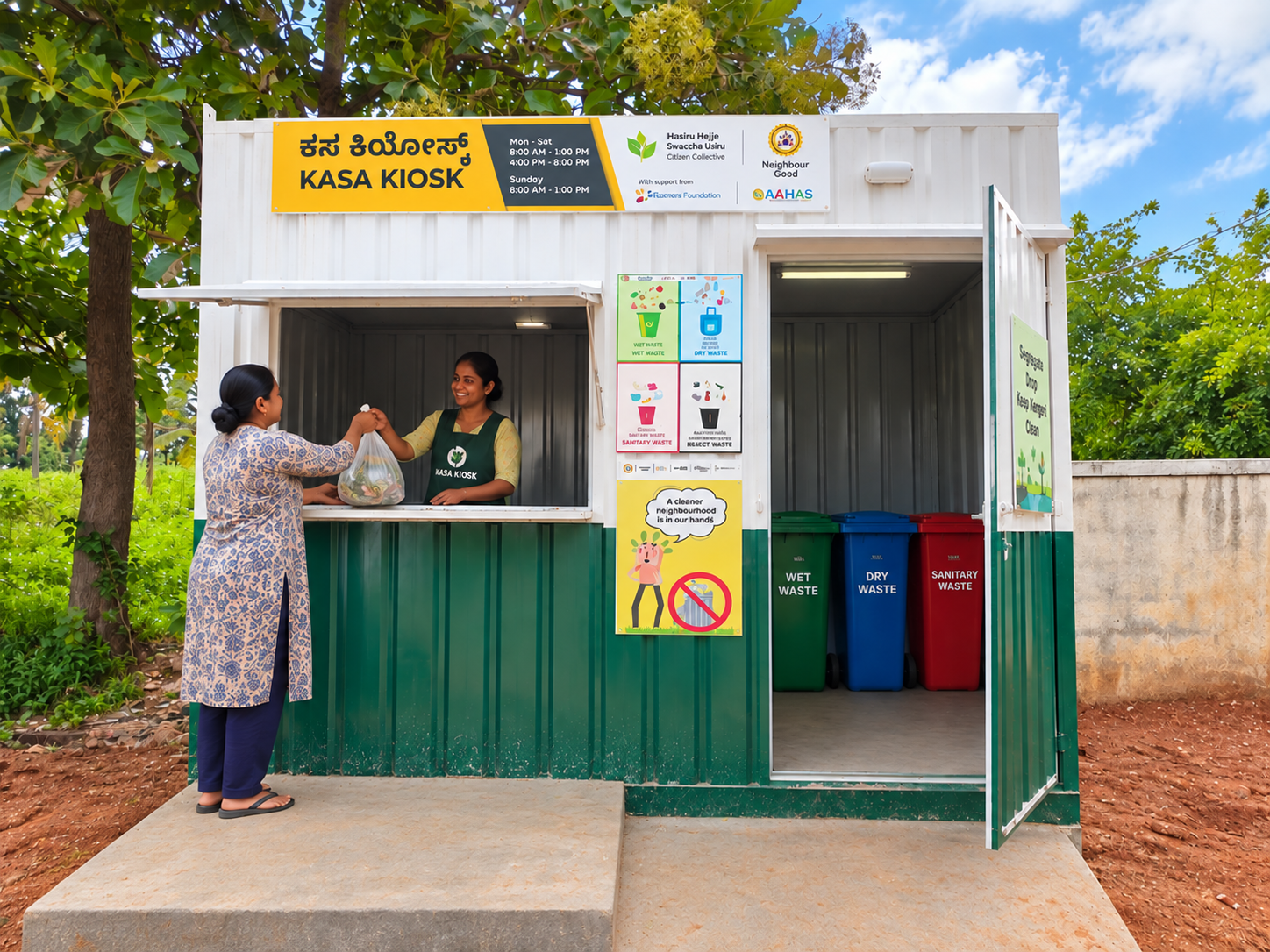

Kitchen and garden waste like food scraps and vegetable peels.
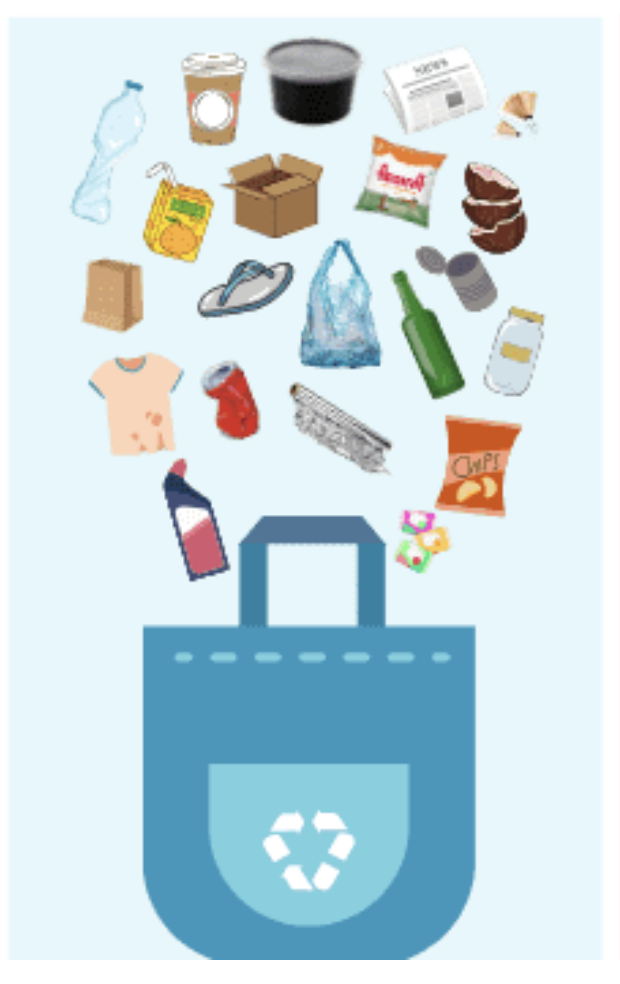
Recyclables like plastic wrappers, cardboard, cans, glass and newspapers.
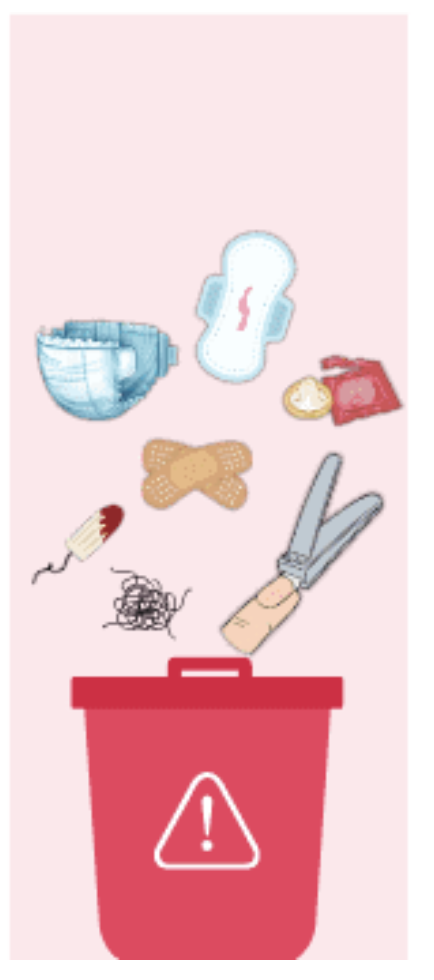
Diapers, sanitary pads, tampons and medical bandages.
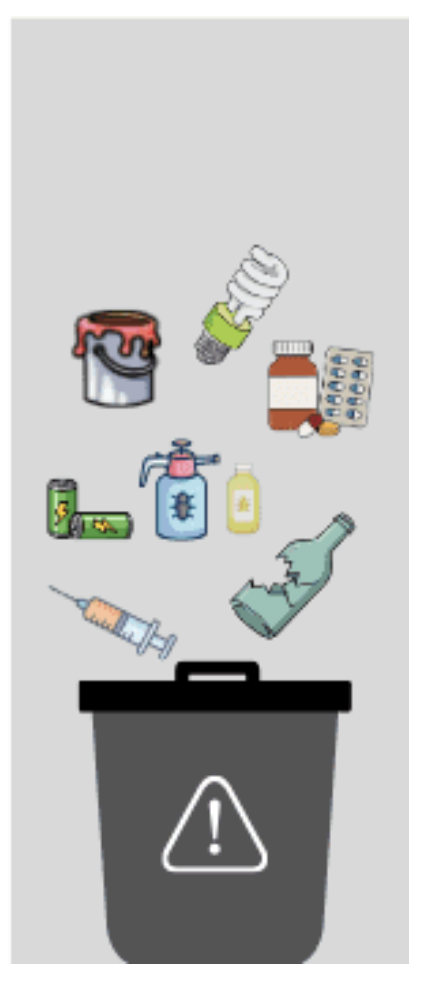
Hazardous items like batteries, CFL bulbs, paint cans and expired medicines.
The Kengeri model is beginning in Doddabele and growing with the community.
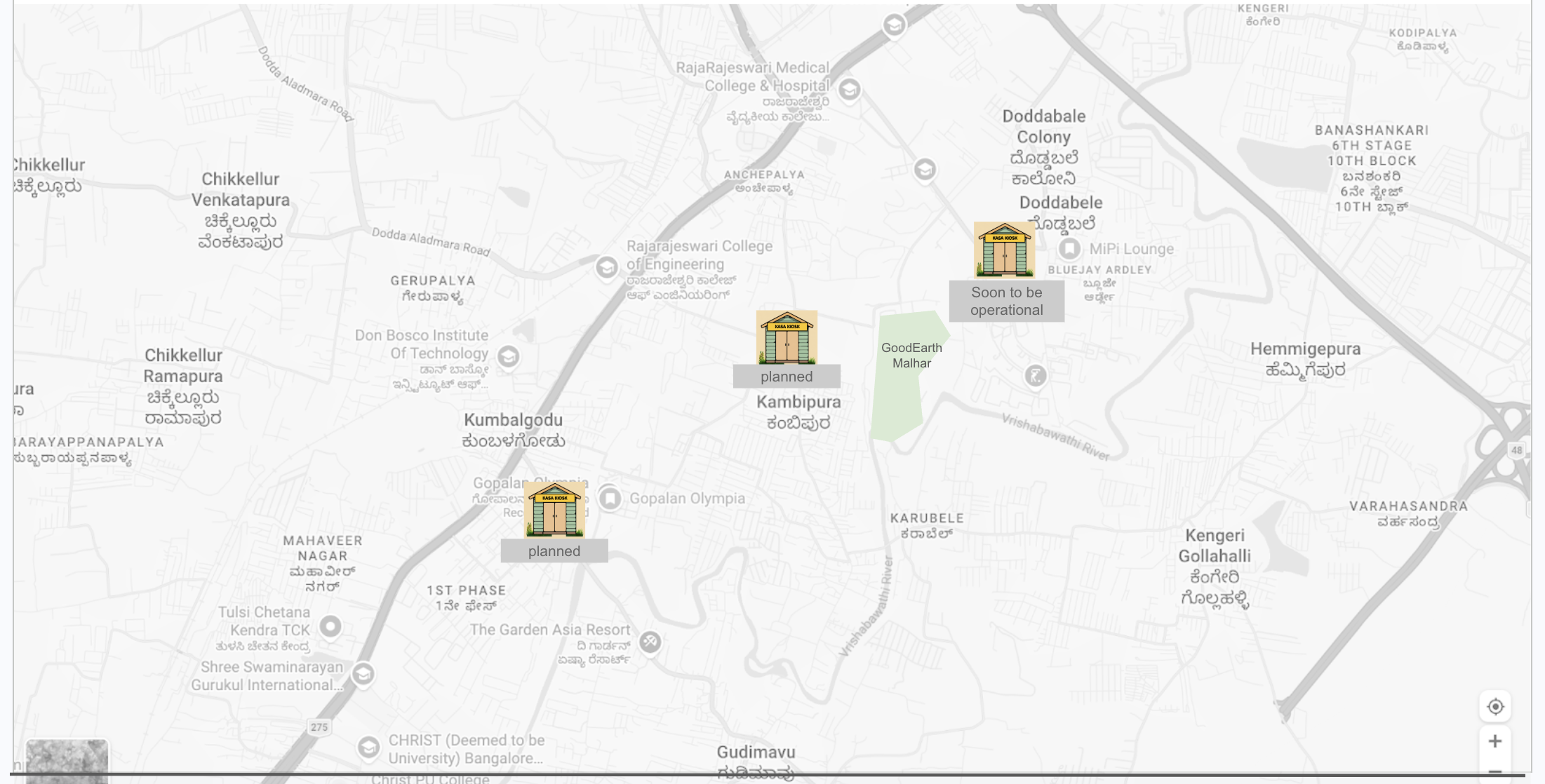 Doddabele is operational. Kambipura and Gopalan Olympia are planned.
Kiosk is open and serving the neighbourhood.
Planned location for the Kengeri area.
Next location in the rollout.
Community support will fund the people and essentials needed to operate and sustain the initiative for one full year.
Pledge your contribution
For contributions below ₹10,000, share your details and someone from our team will reach out to help you complete your pledge.
₹10,000 and above
For larger contributions, use the details below. Please add “Kengeri Kasa Kiosks” as the transfer description.
Receipts & 80G Socratus Foundation will provide an acknowledgement/receipt. Eligible donors will receive an 80G certificate at the end of the financial year.
As the kiosks grow, we'll share what we're learning and where support is making a difference.
The first kiosk at Doddabele is now operational, with two more locations planned.
Planning is underway to bring the model to two more Kengeri neighbourhoods.
Many of us have wondered: Why do we see so much garbage dumped and sometimes burnt along the roads around Kengeri and Kumbalgodu?
The answer is not as simple as people not disposing of their waste properly. There are multiple sources of waste and multiple reasons why it ends up on our roads.
Some waste from Bengaluru city is brought to the Kambipura area for segregation and processing at waste-processing units. What cannot be recovered or sold may ultimately be burnt.
There is also evidence of bulk waste generated within the city being disposed of in locations outside city limits, where disposal is less visible and enforcement is more difficult.
Locally generated waste adds to the problem.
Panchayat waste-collection vehicles do not always reach every household or street regularly. The timing of collection can also be inconvenient, with many residents already having left for work. When waste is not collected, some residents resort to dumping or burning it.
Awareness about segregation is also low. Even when residents segregate their waste before handing it over, the collection vehicle may mix it again.
Waste collection vehicles from some apartments have also been seen disposing of waste along the roads.
There are also small industries and factories dealing with plastic, rubber and metal. Material that cannot be reused or sold has, in some cases, been burnt at night.
And the problem deepens as the amount of waste we generate increases by the day.
For over two years, volunteers have helped clean blackspots, stop waste burning and work with Panchayats and police to close waste-processing units. These interventions helped individual locations, but could not create systemic change.
Hasiru Habba events brought schools, citizens, local organisations and businesses together around segregation, responsible waste management and a plastic-free environment.
A Kasa Kiosk is a responsible, community-level waste collection mechanism designed by Socratus Foundation and Saahas. It gives residents a convenient alternative to roadside dumping, creates awareness about segregation and operates from 6–10 AM and 6–10 PM.
It is an interim solution while the Panchayat strengthens its collection system, based on a model studied in Hebbagodi.
The initiative brings together Panchayats, citizens and NGOs, with each playing a different role.
The Panchayats provide locations, operators and the approvals needed to establish and run the kiosks.
Citizens / Hasiru Hejje Swaccha Usuru Collective: The citizen collective coordinates the initiative, works with stakeholders, builds awareness and encourages residents to segregate and use the kiosks.
Socratus Foundation: Socratus has provided the infrastructure for the first two kiosks and is supporting the initiative with funding and implementation support.
Saahas: Saahas provides technical expertise, knowledge, training and awareness support.
The initiative brings together Panchayats, citizens and NGOs, with each playing a different role.
The Panchayats provide locations, operators and the approvals needed to establish and run the kiosks.
The citizen collective coordinates the initiative, works with stakeholders, builds awareness and encourages residents to segregate and use the kiosks.
Socratus Foundation has provided the infrastructure for the first two kiosks and is supporting the initiative with funding and implementation support.
Saahas provides technical expertise, knowledge, training and awareness support.
H. Gollahalli, K. Gollahalli and Kumbalgodu Panchayats provide locations, operators and approvals. The Hasiru Hejje Swaccha Usiru Collective coordinates awareness and stakeholder engagement. Socratus provides infrastructure and implementation support, while Saahas provides technical expertise, training and awareness support.
The initiative brings together Panchayats, citizens and NGOs, with each playing a different role.
The Panchayats provide locations, operators and the approvals needed to establish and run the kiosks.
Citizens / Hasiru Hejje Swaccha Usuru Collective: The citizen collective coordinates the initiative, works with stakeholders, builds awareness and encourages residents to segregate and use the kiosks.
Socratus Foundation: Socratus has provided the infrastructure for the first two kiosks and is supporting the initiative with funding and implementation support.
Saahas: Saahas provides technical expertise, knowledge, training and awareness support.
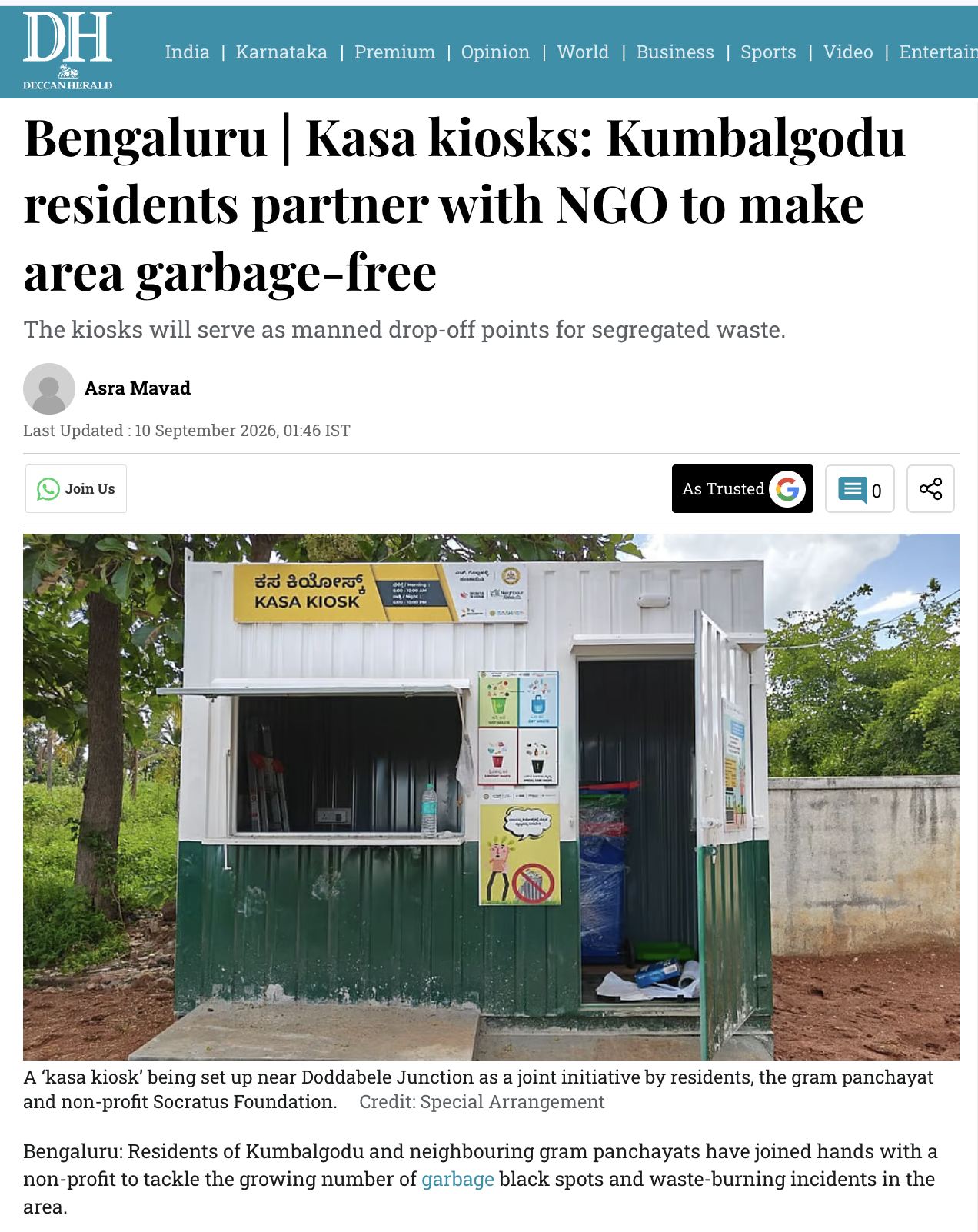
The first kiosk at Doddabele, opposite MiPi Lounge, has been set up with the support of Socratus Foundation and H. Gollahalli Panchayat.
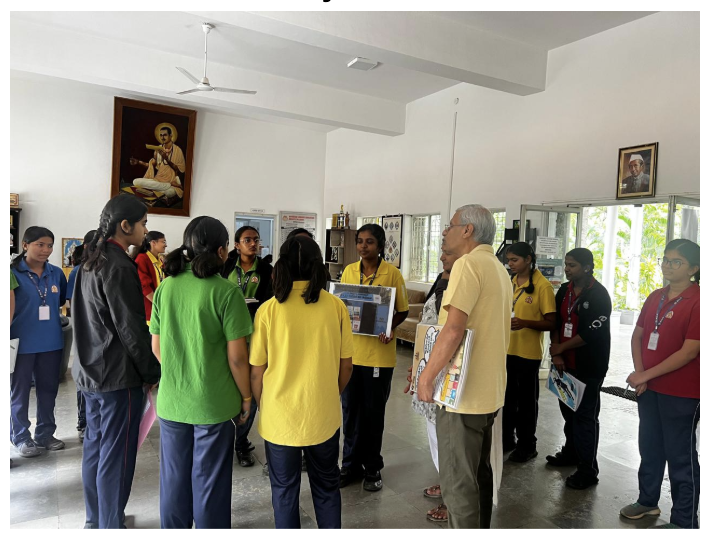
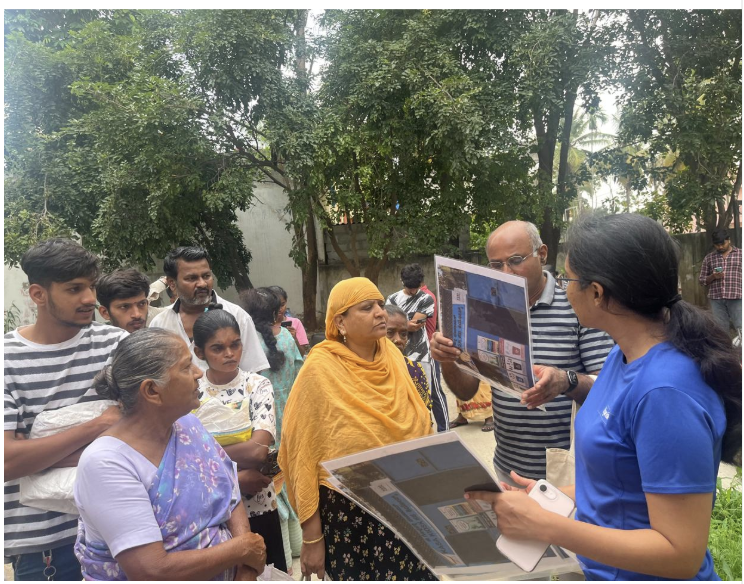
The site has been cleaned, an electrical connection provided and concrete access steps constructed. Operator hiring and trials are underway, with Saahas supporting training and awareness. Basava School students surveyed around 200 households to understand current waste-disposal practices and helped raise awareness about the Kasa Kiosk among these prospective users.
A second kiosk is planned near Tagachaguppe Bridge, close to Gopalan Olympia. Concreting and other preparations are underway, an operator has been identified and awareness activities have started.
A third kiosk near Kumbalgodu/Kambipura is currently paused for lack of funds. Approximately ₹2.5 lakh will be needed to set it up.
The plan is to get the first two kiosks working well and then take up the third.
The first kiosk at Doddabele, opposite MiPi Lounge, was set up with Socratus Foundation and H. Gollahalli Panchayat. The site was cleaned, connected to electricity and given concrete access steps. Basava School students surveyed around 200 households. A second kiosk is planned near Tagachaguppe Bridge, and a third near Kumbalgodu/Kambipura is paused for funding.
Collected waste is intended for appropriate processing: wet waste to farms or composting systems, and dry waste to recovery or recycling. Making the system work smoothly is part of the experiment.
The intention is that collected waste will be taken to appropriate waste-processing facilities.
Wet waste should ultimately go to farms/composting systems, while dry waste should be segregated and sent for recovery or recycling.
There will inevitably be challenges in the beginning — including mixed waste and ensuring timely clearance.
Getting the system to work smoothly is itself part of the experiment.
Before the kiosks become fully operational, baseline data is being collected on the number and volume of waste blackspots within a 500-metre radius of each kiosk.
After six months, we will look for:
This will help us move beyond anecdotal observations and understand whether the intervention is actually making a difference.
Baseline data is being collected within a 500-metre radius of each kiosk. After six months, the team will look for fewer blackspots, less waste at blackspots and the quantity of wet and dry waste collected through the kiosks.
The kiosks sit within the larger framework of the Solid Waste Management Rules, 2026. The Panchayat is also engaging Bulk Waste Generators on segregation, storage and authorised collection.
The Kasa Kiosk is one local, practical step towards better waste management. It sits within the larger framework of the Solid Waste Management Rules, 2026, which came into effect on 1 April 2026. The Rules place responsibilities on waste generators to segregate waste at source and ensure that it is handed over for appropriate collection, processing and disposal.
The Panchayat has also conducted an awareness session for Bulk Waste Generators (BWGs) in the area. At a high level, bulk waste generators — such as larger residential communities, institutions, hotels, restaurants and other establishments generating significant quantities of waste — have greater responsibility for managing the waste they generate. This includes segregation, appropriate storage and ensuring that waste is handed over to authorised collectors/processors, with requirements for managing biodegradable waste where applicable.
This helps position Kasa Kiosk as one part of a broader shift towards responsible waste management, rather than suggesting that it is the complete solution.
Waste dumping and burning is not just a waste-management problem. It is also an air-quality problem.
More than 30 waste-burning spots have been mapped, and AQI monitoring is being carried out using five monitors across the area. The team is working with CSTEP , while weather data from a station at Tarana will help understand the relationship between waste burning, air quality and weather conditions.
You can view the air-quality data being collected by the GoodEarth Community Residents: View Air Quality Monitoring Data
A scientific report documenting the duration and intensity of waste burning over a year is being prepared and will be shared with relevant stakeholders. The aim is to make this information accessible to the community through a public dashboard, while also working with RWAs on waste segregation and awareness of the Solid Waste Management Rules. The objective is to build evidence that can help us understand the problem, engage stakeholders and push for action.
More than 30 waste-burning spots have been mapped and five AQI monitors are being used with CSTEP. Weather data from Tarana will help examine the relationship between waste burning, air quality and weather. A scientific report and public dashboard are being prepared.
That is what we are trying to find out.
The Kasa Kiosk is not expected to solve the entire waste-management problem overnight. It is a practical intervention to create an alternative to roadside dumping, build awareness, improve waste collection and demonstrate what can work.
If we can show that residents use the kiosks, waste is collected and managed better, and blackspots reduce, we will have a model that can potentially be replicated elsewhere.
Kasa Kiosks are one piece of a larger effort to move from reacting to individual blackspots to building a cleaner, more accountable and more sustainable waste-management system.
The Kasa Kiosk is not expected to solve the entire waste-management problem overnight. It is a practical intervention to create an alternative to roadside dumping, build awareness, improve collection and demonstrate what can work and be replicated elsewhere.
The first Kasa Kiosk was initially proposed near Appu Circle. Following objections from Basava representatives and the lack of suitable Panchayat space, the location was reconsidered and the kiosk was eventually established on the lane opposite MiPi Lounge.
The team engaged with the H. Gollahalli Panchayat on the location, cleanup, access, electricity, lighting and operator arrangements. The site was cleaned, an electrical connection was provided and concrete access steps were constructed.
The initiative has involved all three Panchayats, with the PDOs and EO connected through a common WhatsApp group to coordinate the work.
A supervisor has been appointed to oversee operations across the kiosks. He is being trained by Saahas and has spent time observing successful Kasa Kiosk operations in Hebbagodi.
His role will be to help ensure that operators, waste clearance and day-to-day operations function smoothly.
The team is also looking at ways to make the kiosk sites welcoming and community-friendly, including planting greenery and using hardy/native plants around the kiosks.
The first kiosk moved from the proposed Appu Circle location to the lane opposite MiPi Lounge. The site was cleaned and connected to electricity, a supervisor is being trained by Saahas, and the team is planting hardy or native greenery around the kiosks.
Many of us have wondered why we see so much garbage dumped and sometimes burnt along the roads around Kengeri and Kumbalgodu. The answer is not as simple as people not disposing of their waste properly. There are multiple sources of waste and multiple reasons why it ends up on our roads.
Some waste from Bengaluru city is brought to the Kambipura area for segregation and processing. What cannot be recovered or sold may ultimately be burnt. There is also evidence of bulk waste generated within the city being disposed of outside city limits, where disposal is less visible and enforcement is more difficult.
Locally generated waste adds to the problem. Collection vehicles do not always reach every household or street regularly, and collection times can be inconvenient. When waste is not collected, some residents resort to dumping or burning it. Awareness about segregation is also low, and even when residents segregate waste, collection vehicles may mix it again.
Waste vehicles from some apartments have also been seen disposing of waste along roads. Small industries and factories dealing with plastic, rubber and metal have, in some cases, burnt material that cannot be reused or sold. The problem deepens as the amount of waste we generate increases by the day.
For over two years, dedicated volunteers have worked on waste disposal and waste burning in the area. They have helped clean places, stop burning at some locations and put pressure on Panchayats around blackspots, waste burning and plastic-processing facilities. With support from the Panchayat and police, a few such units were shut down.
These interventions made a difference at individual locations, but were largely ad hoc and could not bring systemic change. So the question became: can we try something different?
Hasiru Habba events were initiated to create awareness about waste segregation, encourage responsible waste management, promote a plastic-free environment and strengthen engagement between residents and the Panchayat.
Hasiru Habba 1.0 — 17 January 2026, Anchepalya Government School grounds — featured an awareness walk, skits, a quiz, repair café, waste-awareness stalls, Kaasu for Kasa, a health camp, games and cultural performances.
Hasiru Habba 2.0 — 1 March 2026, Yuva Tarabati Kendra, Kumbalgodu — included plastic-ban awareness, distribution of 1,500 jute bags, Kaasu for Kasa, paper recycling, cycle repair, games, skits, mime and community installations.
A Kasa Kiosk is a responsible, community-level waste collection mechanism designed by Socratus Foundation and Saahas. It gives residents a convenient place to hand over waste instead of dumping it roadside, creates awareness about segregation and helps prevent littering. Kiosks operate during two convenient windows: 6–10 AM and 6–10 PM.
This is an interim solution while the Panchayat strengthens its collection system. The model has been tried in Hebbagodi, where Saahas and Socratus have set up several kiosks. After studying the model, the team felt it could work here as a practical starting point.
The initiative brings together Panchayats, citizens and NGOs, with each playing a different role.
The Panchayats provide locations, operators and the approvals needed to establish and run the kiosks.
Citizens / Hasiru Hejje Swaccha Usuru Collective: The citizen collective coordinates the initiative, works with stakeholders, builds awareness and encourages residents to segregate and use the kiosks.
Socratus Foundation: Socratus has provided the infrastructure for the first two kiosks and is supporting the initiative with funding and implementation support.
Saahas: Saahas provides technical expertise, knowledge, training and awareness support.
The initiative brings together Panchayats, citizens and NGOs, with each playing a different role.
The Panchayats provide locations, operators and the approvals needed to establish and run the kiosks.
The citizen collective coordinates the initiative, works with stakeholders, builds awareness and encourages residents to segregate and use the kiosks.
Socratus Foundation has provided the infrastructure for the first two kiosks and is supporting the initiative with funding and implementation support.
Saahas provides technical expertise, knowledge, training and awareness support.
The Panchayats provide locations, operators and approvals. The Hasiru Hejje Swaccha Usiru citizen collective coordinates the initiative, builds awareness and encourages residents to segregate and use the kiosks. Socratus Foundation provides infrastructure and funding support, while Saahas provides technical expertise, training and awareness support.
The first kiosk at Doddabele, opposite MiPi Lounge, has been set up with the support of Socratus Foundation and H. Gollahalli Panchayat.
The site has been cleaned, an electrical connection provided and concrete access steps constructed. Operator hiring and trials are underway, with Saahas supporting training and awareness. Basava School students surveyed around 200 households to understand current waste-disposal practices and helped raise awareness about the Kasa Kiosk among these prospective users.
A second kiosk is planned near Tagachaguppe Bridge, close to Gopalan Olympia. Concreting and other preparations are underway, an operator has been identified and awareness activities have started.
A third kiosk near Kumbalgodu/Kambipura is currently paused for lack of funds. Approximately ₹2.5 lakh will be needed to set it up.
The plan is to get the first two kiosks working well and then take up the third.
The first kiosk at Doddabele, opposite MiPi Lounge, has been set up with the support of Socratus Foundation and H. Gollahalli Panchayat.
The site has been cleaned, an electrical connection provided and concrete access steps constructed. Operator hiring and trials are underway, with Saahas supporting training and awareness. Basava School students surveyed around 200 households to understand current waste-disposal practices and helped raise awareness about the Kasa Kiosk among these prospective users.
A second kiosk is planned near Tagachaguppe Bridge, close to Gopalan Olympia. Concreting and other preparations are underway, an operator has been identified and awareness activities have started.
A third kiosk near Kumbalgodu/Kambipura is currently paused for lack of funds. Approximately ₹2.5 lakh will be needed to set it up.
The plan is to get the first two kiosks working well and then take up the third.
The first kiosk at Doddabele, opposite MiPi Lounge, was set up with Socratus Foundation and H. Gollahalli Panchayat. The site was cleaned, electricity provided and access steps constructed. Operator hiring and trials are underway, with Saahas supporting training and awareness. Basava School students surveyed around 200 households and helped introduce the kiosk to prospective users.
A second kiosk is planned near Tagachaguppe Bridge, close to Gopalan Olympia. A third near Kumbalgodu/Kambipura is paused for lack of funds; approximately ₹2.5 lakh will be needed to set it up.
Collected waste is intended to go to appropriate processing facilities. Wet waste should ultimately go to farms or composting systems, while dry waste should be segregated and sent for recovery or recycling. There will be challenges in the beginning, including mixed waste and timely clearance. Getting the system to work smoothly is part of the experiment.
The intention is that collected waste will be taken to appropriate waste-processing facilities.
Wet waste should ultimately go to farms/composting systems, while dry waste should be segregated and sent for recovery or recycling.
There will inevitably be challenges in the beginning — including mixed waste and ensuring timely clearance.
Getting the system to work smoothly is itself part of the experiment.
Before the kiosks become fully operational, baseline data is being collected on the number and volume of waste blackspots within a 500-metre radius of each kiosk.
After six months, we will look for:
This will help us move beyond anecdotal observations and understand whether the intervention is actually making a difference.
Baseline data is being collected on waste blackspots within a 500-metre radius of each kiosk. After six months, we will look for a reduction in the number of blackspots, a reduction in the volume of waste at blackspots, and the quantity of wet and dry waste collected through the kiosks.
The Kasa Kiosk is one local step towards better waste management. It sits within the larger framework of the Solid Waste Management Rules, 2026, which place responsibilities on waste generators to segregate at source and hand waste over for appropriate collection, processing and disposal.
Waste dumping and burning is also an air-quality problem. More than 30 waste-burning spots have been mapped, and AQI monitoring is being carried out using five monitors across the area with CSTEP and weather data from Tarana. A scientific report documenting waste burning over a year is being prepared and will be shared with stakeholders.
That is what we are trying to find out.
The Kasa Kiosk is not expected to solve the entire waste-management problem overnight. It is a practical intervention to create an alternative to roadside dumping, build awareness, improve waste collection and demonstrate what can work.
If we can show that residents use the kiosks, waste is collected and managed better, and blackspots reduce, we will have a model that can potentially be replicated elsewhere.
Kasa Kiosks are one piece of a larger effort to move from reacting to individual blackspots to building a cleaner, more accountable and more sustainable waste-management system.
That is what we are trying to find out. The Kasa Kiosk is not expected to solve the entire waste-management problem overnight. It is a practical intervention to create an alternative to roadside dumping, build awareness, improve waste collection and demonstrate what can work.
If residents use the kiosks, waste is managed better and blackspots reduce, we will have a model that can potentially be replicated elsewhere. Kasa Kiosks are one piece of a larger effort to move from reacting to individual blackspots to building a cleaner, more accountable and more sustainable waste-management system.
Many of us have wondered: Why do we see so much garbage dumped and sometimes burnt along the roads around Kengeri and Kumbalgodu?
The answer is not as simple as people not disposing of their waste properly. There are multiple sources of waste and multiple reasons why it ends up on our roads.
Some waste from Bengaluru city is brought to the Kambipura area for segregation and processing at waste-processing units. What cannot be recovered or sold may ultimately be burnt.
There is also evidence of bulk waste generated within the city being disposed of in locations outside city limits, where disposal is less visible and enforcement is more difficult.
Locally generated waste adds to the problem.
Panchayat waste-collection vehicles do not always reach every household or street regularly. The timing of collection can also be inconvenient, with many residents already having left for work. When waste is not collected, some residents resort to dumping or burning it.
Awareness about segregation is also low. Even when residents segregate their waste before handing it over, the collection vehicle may mix it again.
Waste collection vehicles from some apartments have also been seen disposing of waste along the roads.
There are also small industries and factories dealing with plastic, rubber and metal. Material that cannot be reused or sold has, in some cases, been burnt at night.
And the problem deepens as the amount of waste we generate increases by the day.
For over two years, a few dedicated volunteers have been working on waste disposal and waste burning in the area. They have helped get some places cleaned up and managed to stop waste burning at some locations. The collective continues to put pressure on the Panchayats on blackspots, waste burning and plastic-processing facilities.
With the help of the Panchayat and police, a few such units — including a large and a small one — were also shut down.
These interventions made a difference at individual locations, but they were largely ad-hoc and could not bring about systemic change in the way waste is collected, transported and processed.
So the question became: Can we try something different?
The Hasiru Habba events were initiated to create awareness about waste segregation, encourage responsible waste management, promote a plastic-free environment and strengthen engagement between residents and the Panchayat. They also provided an opportunity for schools, citizens, local organisations and businesses to come together and take collective action.
Two events were conducted:
Anchepalya Government School grounds. Organised by Kumbalgodu Gram Panchayat with community support, the event featured an awareness walk by school students, skits and a quiz, a repair café, waste-awareness stalls, Kaasu for Kasa, a health check-up camp, games and cultural performances. It also marked the launch of the Hasiru Hejje Swaccha Usiru Citizen Collective.
Yuva Tarabati Kendra, Kumbalgodu. The second event focused on continuing engagement with the Panchayat and initiating conversations around the plastic ban, waste dumping and waste burning. Highlights included plastic-ban awareness and distribution of 1,500 jute bags to vendors, Kaasu for Kasa, paper recycling, cycle repair, games by Decathlon, skits and mime by Gopalan Public School, handmade installations and other community activities. Approximately 15 kg of new plastic bags and 30 kg of waste through Kaasu for Kasa were collected.
Together, the events helped build awareness, strengthen partnerships and demonstrate the community's commitment to a cleaner, greener and pollution-free Kumbalgodu.
A Kasa Kiosk is a responsible, community-level waste collection mechanism designed by Socratus Foundation and Saahas.
It provides residents with a convenient place to hand over their waste instead of dumping it on the roadside. The kiosks also create awareness about waste segregation and help prevent littering.
The kiosks operate during two convenient windows: 6–10 AM and 6–10 PM.
This is an interim solution while the Panchayat works to strengthen its waste collection system.
The model has been tried in Hebbagodi, where Saahas and Socratus have set up several kiosks. After visiting and studying the model, the team felt that it could work in our area too — as a practical starting point to reduce blackspots, build awareness and demonstrate what is possible.
The initiative brings together Panchayats, citizens and NGOs, with each playing a different role.
The Panchayats provide locations, operators and the approvals needed to establish and run the kiosks.
Citizens / Hasiru Hejje Swaccha Usuru Collective: The citizen collective coordinates the initiative, works with stakeholders, builds awareness and encourages residents to segregate and use the kiosks.
Socratus Foundation: Socratus has provided the infrastructure for the first two kiosks and is supporting the initiative with funding and implementation support.
Saahas: Saahas provides technical expertise, knowledge, training and awareness support.
The initiative brings together Panchayats, citizens and NGOs, with each playing a different role.
The Panchayats provide locations, operators and the approvals needed to establish and run the kiosks.
The citizen collective coordinates the initiative, works with stakeholders, builds awareness and encourages residents to segregate and use the kiosks.
Socratus Foundation has provided the infrastructure for the first two kiosks and is supporting the initiative with funding and implementation support.
Saahas provides technical expertise, knowledge, training and awareness support.
The initiative brings together Panchayats, citizens and NGOs, with each playing a different role.
The Panchayats provide locations, operators and the approvals needed to establish and run the kiosks.
The citizen collective coordinates the initiative, works with stakeholders, builds awareness and encourages residents to segregate and use the kiosks.
Socratus Foundation has provided the infrastructure for the first two kiosks and is supporting the initiative with funding and implementation support.
Saahas provides technical expertise, knowledge, training and awareness support.
The initiative brings together Panchayats, citizens and NGOs, with each playing a different role.
The Panchayats provide locations, operators and the approvals needed to establish and run the kiosks.
Citizens / Hasiru Hejje Swaccha Usuru Collective: The citizen collective coordinates the initiative, works with stakeholders, builds awareness and encourages residents to segregate and use the kiosks.
Socratus Foundation: Socratus has provided the infrastructure for the first two kiosks and is supporting the initiative with funding and implementation support.
Saahas: Saahas provides technical expertise, knowledge, training and awareness support.
The first kiosk at Doddabele, opposite MiPi Lounge, has been set up with the support of Socratus Foundation and H. Gollahalli Panchayat.
The site has been cleaned, an electrical connection provided and concrete access steps constructed. Operator hiring and trials are underway, with Saahas supporting training and awareness. Basava School students surveyed around 200 households to understand current waste-disposal practices and helped raise awareness about the Kasa Kiosk among these prospective users.
A second kiosk is planned near Tagachaguppe Bridge, close to Gopalan Olympia. Concreting and other preparations are underway, an operator has been identified and awareness activities have started.
A third kiosk near Kumbalgodu/Kambipura is currently paused for lack of funds. Approximately ₹2.5 lakh will be needed to set it up.
The plan is to get the first two kiosks working well and then take up the third.
The intention is that collected waste will be taken to appropriate waste-processing facilities.
Wet waste should ultimately go to farms/composting systems, while dry waste should be segregated and sent for recovery or recycling.
There will inevitably be challenges in the beginning — including mixed waste and ensuring timely clearance.
Getting the system to work smoothly is itself part of the experiment.
The intention is that collected waste will be taken to appropriate waste-processing facilities.
Wet waste should ultimately go to farms/composting systems, while dry waste should be segregated and sent for recovery or recycling.
There will inevitably be challenges in the beginning — including mixed waste and ensuring timely clearance.
Getting the system to work smoothly is itself part of the experiment.
Before the kiosks become fully operational, baseline data is being collected on the number and volume of waste blackspots within a 500-metre radius of each kiosk.
After six months, we will look for:
This will help us move beyond anecdotal observations and understand whether the intervention is actually making a difference.
The Kasa Kiosk is one local, practical step towards better waste management. It sits within the larger framework of the Solid Waste Management Rules, 2026, which came into effect on 1 April 2026. The Rules place responsibilities on waste generators to segregate waste at source and ensure that it is handed over for appropriate collection, processing and disposal.
The Panchayat has also conducted an awareness session for Bulk Waste Generators (BWGs) in the area. At a high level, bulk waste generators — such as larger residential communities, institutions, hotels, restaurants and other establishments generating significant quantities of waste — have greater responsibility for managing the waste they generate. This includes segregation, appropriate storage and ensuring that waste is handed over to authorised collectors/processors, with requirements for managing biodegradable waste where applicable.
This helps position Kasa Kiosk as one part of a broader shift towards responsible waste management, rather than suggesting that it is the complete solution.
The Kasa Kiosk is one local, practical step towards better waste management. It sits within the larger framework of the Solid Waste Management Rules, 2026, which came into effect on 1 April 2026. The Rules place responsibilities on waste generators to segregate waste at source and ensure that it is handed over for appropriate collection, processing and disposal.
The Panchayat has also conducted an awareness session for Bulk Waste Generators (BWGs) in the area. At a high level, bulk waste generators — such as larger residential communities, institutions, hotels, restaurants and other establishments generating significant quantities of waste — have greater responsibility for managing the waste they generate. This includes segregation, appropriate storage and ensuring that waste is handed over to authorised collectors/processors, with requirements for managing biodegradable waste where applicable.
This helps position Kasa Kiosk as one part of a broader shift towards responsible waste management, rather than suggesting that it is the complete solution.
Waste dumping and burning is not just a waste-management problem. It is also an air-quality problem.
More than 30 waste-burning spots have been mapped, and AQI monitoring is being carried out using five monitors across the area. The team is working with CSTEP , while weather data from a station at Tarana will help understand the relationship between waste burning, air quality and weather conditions.
You can view the air-quality data being collected by the GoodEarth Community Residents: View Air Quality Monitoring Data
A scientific report documenting the duration and intensity of waste burning over a year is being prepared and will be shared with relevant stakeholders. The aim is to make this information accessible to the community through a public dashboard, while also working with RWAs on waste segregation and awareness of the Solid Waste Management Rules. The objective is to build evidence that can help us understand the problem, engage stakeholders and push for action.
That is what we are trying to find out.
The Kasa Kiosk is not expected to solve the entire waste-management problem overnight. It is a practical intervention to create an alternative to roadside dumping, build awareness, improve waste collection and demonstrate what can work.
If we can show that residents use the kiosks, waste is collected and managed better, and blackspots reduce, we will have a model that can potentially be replicated elsewhere.
Kasa Kiosks are one piece of a larger effort to move from reacting to individual blackspots to building a cleaner, more accountable and more sustainable waste-management system.
The first Kasa Kiosk was initially proposed near Appu Circle. Following objections from Basava representatives and the lack of suitable Panchayat space, the location was reconsidered and the kiosk was eventually established on the lane opposite MiPi Lounge.
The team engaged with the H. Gollahalli Panchayat on the location, cleanup, access, electricity, lighting and operator arrangements. The site was cleaned, an electrical connection was provided and concrete access steps were constructed.
The initiative has involved all three Panchayats, with the PDOs and EO connected through a common WhatsApp group to coordinate the work.
A supervisor has been appointed to oversee operations across the kiosks. He is being trained by Saahas and has spent time observing successful Kasa Kiosk operations in Hebbagodi.
His role will be to help ensure that operators, waste clearance and day-to-day operations function smoothly.
The team is also looking at ways to make the kiosk sites welcoming and community-friendly, including planting greenery and using hardy/native plants around the kiosks.
Coverage of the community-led work to make Kumbalgodu and its surroundings cleaner.
A visual record of the places and moments shaping the Kasa Kiosks response.